
Earlier this year, we shared why interoperability matters to One Degree: when systems don’t talk to each other, the burden of connecting them falls on frontline workers and the people seeking help.
Today, we’re excited to share an important milestone: One Degree’s FHIR integration is live.
FHIR (Fast Healthcare Interoperability Resources) is a widely used standard that allows different systems to exchange information in a consistent, structured way. For One Degree, implementing FHIR means referrals can move between One Degree and partner systems without requiring frontline workers to manually transfer information between platforms.
What does that look like in practice?
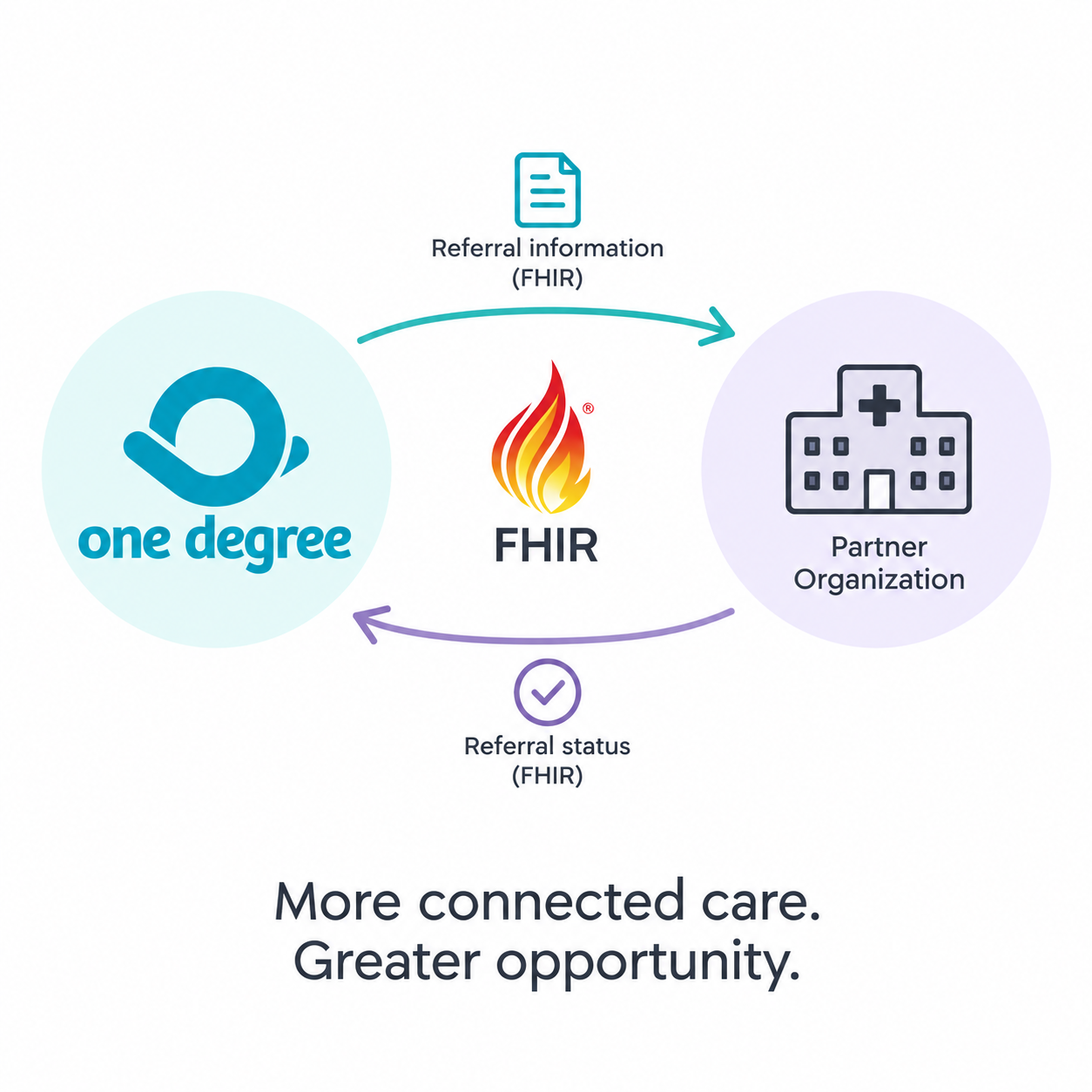
When a frontline worker creates a referral in One Degree, a structured referral record can now flow directly into a partner organization’s system in a format its software already understands.
And the exchange goes both ways. When the partner takes action on that referral—such as accepting, completing, or closing it—the updated status can flow back to One Degree in real time.
That means frontline workers can see what happened to a referral without having to leave One Degree to make a phone call, send an email, or check another system.
Building on shared standards
Our integration uses FHIR, the same interoperability standard used across healthcare systems, and follows the Gravity Project’s Social Determinants of Health (SDOH) guidelines for representing social needs information.
That matters for scale. By building around established standards rather than creating a different custom integration for every organization, we’re laying the foundation to connect One Degree with more partners and systems over time.
This milestone builds on our collaboration with Elimu Informatics and is supported by the California Data Exchange Framework (DxF) Technical Assistance Grant.
We’ve long believed that interoperability isn’t an add-on. It’s foundational infrastructure for a more connected social safety net. Shipping our FHIR integration brings us one step closer to that vision.
Read our January post on why California’s DxF and interoperability matter