
For the past twenty-five years, a lot of the energy in the social sector has gone into solving what is a core problem: helping people find the services they need, when they need them.
Together communities have built resource directories, call centers, referral platforms, coordinated care networks, and information exchanges. And it has worked. In fact, the national 211 network now covers 99% of Americans. Information that once lived in binders on a caseworker’s desk is now searchable online. That progress is real, and it matters.
But here’s what we’ve learned after more than a decade building One Degree: finding a service and successfully accessing that service are two very different things.
A parent who gets a referral for childcare assistance still has to complete intake forms, gather documents, verify income, coordinate appointments, and follow up across multiple agencies — often with no shared process, no common intake, and no one able to keep track of whether any of the providers have the capacity to help. Often a referral is just the beginning of an obstacle course most families were never told they’d have to run.
The social safety net doesn’t just have a referral problem. It also has an enrollment problem.
Why We Wrote This White Paper
We’ve been thinking about this for a while at One Degree. And over the past year, as advances in artificial intelligence have started to change what’s actually possible — in conversational intake, document processing, eligibility screening, multilingual support, workflow automation — we felt it was time to put our thinking on paper.
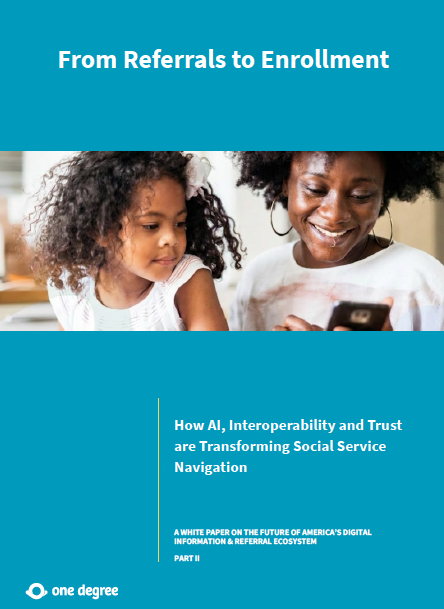
Today, we’re publishing the second in our white paper series on the future of America’s digital information and referral ecosystem:
From Referrals to Enrollment: How AI, Interoperability and Trust are Transforming Social Service Navigation
It’s a paper about a shift we think is already underway, even if it isn’t fully visible yet. The shift from referral infrastructure to enrollment infrastructure.
What That Shift Looks Like
Enrollment infrastructure isn’t about replacing caseworkers or automating decisions. It’s about removing the administrative friction that still keeps too many families from getting the help that they need.
Think about what that could look like in practice. Intake that happens through a conversation, not a form. Eligibility screening that’s dynamic and personalized, not a static PDF. Follow-up that’s proactive, not dependent on whether a family remembers to call back. Document workflows that don’t require a person to fax the same paperwork to five different agencies.
None of this is science fiction. The tools to build it exist. What’s been missing is the infrastructure to connect them — and the shared will to invest in building that infrastructure as a public good rather than a proprietary product.
Why 211 Matters Here
At the center of this opportunity is an asset that doesn’t get enough attention: America’s 211 network.
For more than two decades, 211 organizations have been the trusted community gateways to the social safety net. Their value isn’t just their data. It’s their relationships. Their local knowledge. Their accountability to communities rather than to shareholders.
That matters enormously right now — in a moment when everyone is asking hard questions about data governance, AI ethics, and who should own the infrastructure that connects people to services. 211 organizations have a unique opportunity to serve as the backbone of enrollment infrastructure precisely because their mission has never been to monetize the people they serve.
But many of those systems are running on technology that was designed for a pre-internet world. The opportunity — and the urgency — is real.
A Note on AI
We know AI is a loaded word in this sector. A few months ago we spoke at a Health Leads webinar on AI and health equity, and the fear in the chatroom from people doing this work every day stayed with us.
That fear is understandable. And a lot of the concerns people raised — about bias, reliability, data governance, corporate power — are legitimate. We share them.
But the answer to those concerns isn’t to step back. It’s to step forward. If the social sector, the public sector, and community-based organizations don’t actively participate in shaping how AI gets applied to service navigation, it will still get built — just by someone else, with different incentives.
We wrote this white paper partly as an invitation: to funders, to policymakers, to 211 leaders, to healthcare systems, to anyone who believes that the infrastructure connecting people to help should be built in the public interest.
Read the White Paper
[Download “From Referrals to Enrollment” →]
We’d love to hear your reactions. What are you seeing in your own work? Where are the enrollment gaps showing up for the communities you serve?
This conversation is just getting started.
—
One Degree is an Oakland-based nonprofit empowering people to build healthy and fulfilling lives by improving access to life-changing social services. Learn more at about.1degree.org